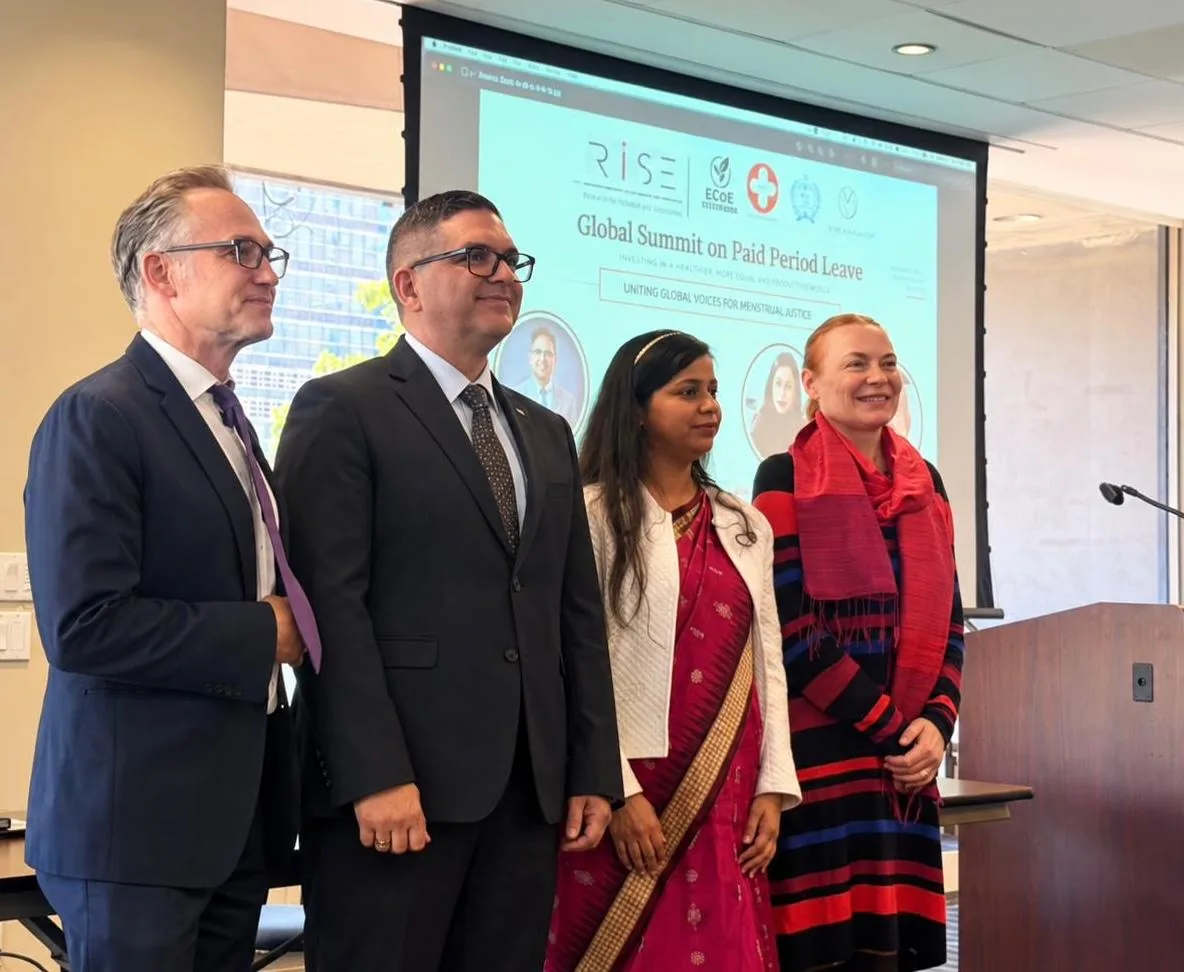
Ambassador Emmett Imani, Chairman and President of the Global Council of Turk Communities and Heritage (GCTCH) and Deputy Director of the UNESCO Center for Peace, took part in a panel at the Global Summit on Paid Period Leave on 19 October 2026 at the United Nations Conference Center (UNCC) in New York.
The summit, held under the theme “Uniting Global Voices for Menstrual Justice”, was organised by RISE — Ranjeeta Initiative for Social Empowerment Foundation. Ambassador Imani shared the panel with Adam Lupel, Executive Director of the Coalition for the UN We Need; Ranjeeta Priyadarshini, global campaigner and founder of Paid Period Leave; and Anna Kaplan, Adjunct Professor at the City University of New York.
Dignity in everyday life
Asked why paid period leave belongs on a global agenda of equality and human dignity, Imani said:
I believe that when we talk about human dignity, we must look beyond major international issues and pay attention to what people experience in their everyday lives.
Paid period leave, he said, is not about suggesting that women are less capable; it is about recognising that people have different health needs, and that fair workplaces should respond to them with understanding and respect. Drawing on his work at the UNESCO Center for Peace, he added that peace is not simply the absence of war: it also requires societies in which individuals feel respected, protected and valued.
Heritage and responsibility
Turning to the Council’s own mission, Imani spoke of women across the Turk world — in Türkiye, Azerbaijan, Kazakhstan, Kyrgyzstan, Uzbekistan and Turkmenistan, and among Uyghur, Crimean Tatar, Qashqai, Afshar, Ahıska Turk and many other communities — who share historical and cultural connections but not necessarily the same social circumstances or access to health care.
The Council’s role, he said, is not to replace medical institutions or to speak on behalf of women, but to support research, encourage informed dialogue and create opportunities for women from different Turk communities to share their own experiences and perspectives.
Preserving heritage must go hand in hand with respecting the people who carry that heritage into the future.
Policies that improve lives
Imani noted that countries differ in their economies, labour systems and health care, so a policy that works in one may need adapting in another. What matters is the principle: a woman with debilitating symptoms should not have to choose between protecting her health and earning her living. Workplace protections, he said, should safeguard medical privacy, prevent discrimination in hiring and promotion, and also reach women working in agriculture, domestic employment and the informal economy.
A good policy is not simply one that looks impressive on paper. It is one that actually improves people’s lives.
Women, Heritage and Human Dignity
Ambassador Imani said the Council would welcome the opportunity to explore a research and dialogue initiative under the theme “Women, Heritage and Human Dignity”, bringing together women researchers, health-care professionals, educators and community organisations to examine women’s health, educational opportunities and workplace dignity across different communities — beginning by listening and gathering reliable evidence. He thanked Ranjeeta Priyadarshini for helping to bring the conversation to the international stage.
Heritage is not merely what we receive from the past. It is the responsibility we accept for the future.
Photos from the summit
Ambassador Imani speaks on the panel. Photo: GCTCH Ambassador Imani with the panel speakers after the session, 19 October 2026. Photo: GCTCH
Related: Ambassador Emmett Imani to attend the Global Summit on Paid Period Leave.